Slowing Down for the Summer

I am slowing down with the hot weather and the summer being here, or at least here for the next 5 minutes. I got very excited with the possibility to write on the BBCgoodfood blog but though I was shortlisted among thousand of entries, I did not make it. So I need to recharge, I will be away for a month. When I come back you can look forward to new categories: I have signed in to be a member of the "Daring bakers" and since the office has been redecorated and the computer back where it should be, I have access to the sound system so postswith music will be back on the menu. I also decided to post the book reviews I write for Paper Palate and as it is I will leave you with one to savour.


Already, I hear you say. It will be no time before they leave home again to their respective universities and colleges, resuming their busy students' lives; the question is "WHAT WILL THEY EAT THEN?" here is a book which title is a bit of a mouthful but will ease parents' worries. "The Really Useful Ultimate Student Vegetarian Cook Book" by Helen Aitken.

2 categories of recipes easy and very easy, the blurbs around the recipes are comprehensive and informative, the recipes themselves are easy to follow though some of them are not particularly on the cheap side on a student's budget as we are talking cooking and not throwing lentils in a pot. They are all accurate and will provide a myriad of variations a meal time, the recipes are suitable for beginners, tried and tested so success is assured.
I put the book to the test, asked around me, quickly realising that very little cooking was going on among young adults or if cooking was taking place it was mostly the old favorite such as pasta, so with 40 pages of pasta recipes it will hit the target. On the other end, the most enthusiastic cooks often googled the ingredients available in the fridge or cupboard so will they use a cook book? the answer remains a mystery but if they did "The Really Useful Ultimate Student Vegetarian Cook Book" would be a good choice?
I put it to the taste, there are 6 chapiters: soups, pastas and noodles, rice, grains and pulses, casseroles, curries and bakes, stir fires, salads and vegetables, breakfast, snacks and standbys. I cooked Chickpeas Patties with Caramelised Onions, it will not reach my top 10 but I realised that I hardly ever cook my onions that way and that I should they were delicious.
Ingredients
½ tablespoon olive oil
1 egg, lightly beaten
15g of fresh coriander , roughly chopped
310g can chickpeas , drained and rinsed
35g besan flour
1 small red onion , finely chopped
1 garlic clove, crushed
½ tsp ground cumin
2 tbsp plain flour
oil, for shallow-frying
15g sunflower seeds
caramelised onion
20g butter
1red onion, thinly sliced
1½ teaspoons soft brown sugar
plain yogurt, to serve
Besan flour is also known as chickpea flour
Heat the oil in a frying pan, add the onion and cook over medium heat for 3 minutes, or until soft. Add the garlic and cumin and cook for 1 minute. Allow to cool slightly.
Blend the drained chickpeas, sunflower seeds, coriander, eff and onion mixture in a food processor until smooth. Fold in the besan lour and season. Divide the mixture into four portions and, using floured hands, form into patties. Heat 1 cm oil in a frying pan and cook the patties in two batches over medium heat for 2-3 minutes each side, or until firm. Drain on paper towels. Keep warm.
to make the caramelised onion, melt the butter in a small frying pan and cook the onion over medium heat for 10 minutes, stirring occasionally. Add the sugar and cook for 1 minute, or until caramelised. Spoon over the patties with a dollop of yogurt.
Easy
50 minutes
serves 2 .

Worthy of a Restaurant

The great thing about food writing is that you are taken on little adventures all the time. As I wrote a review of Feast Bazaar, a page about Argan oil caught my imagination. Forest of Argan trees cover large areas in the Essouira region (Morocco), where the Berber community and my maternal ancestors settled.
The fruit which is a hard nut, the size of a plum contains one to three kernels, 100kg of seed yield 1 to 2 kg of oil, which make it the caviar of oils.
Though this oil has a plethora of benefits being rich in polyunsaturated fatty acid, see below for full composition, it reduces cholesterol & containing large amounts of vitamin E, what impressed me most was the production which is done entirely by hand mostly by the community of women.

After some research, I obtain a bottle from Belazu, a company which seems to have its heart at the right place, reinvesting money in good causes such as building a school in a village they work with. They import North-African / Mediterranean top quality products, have hit "fame" with their rose harissa. Argan oil has a deep golden tint to it, as soon as you open the bottle the aroma jumps out like the Genie tickling your nostrils with nuttiness and "spiciness" Anxious to try straight away I chose to a simple recipe, the result was heavenly, the nutty flavour of the oil really makes it gold. I am so taken that I am considering a visit to the land of my ancestors.

CHICKEN and MANGO SALAD WITH ARGAN OIL VINAIGRETTE

here is the recipe, The secret of a good vinaigrette is "use a fork"

In a bowl beat a tablespoon full of mustard, salt and pepper, season well with salt and pepper keep stirring, add a couple of dashes of vinegar, here you will need a non-obstructive kind, wine vinegar, for example, add 2 tbs of Argan oil, one of vegetable oil, one spoon at the time, stirring the entire time. The consistency remains thick if it gets too thin top up the mustard.
For the salad: in a bowl mix 1 cooked and cubed chicken breast without the skin, 1/2 mango cubed, as much green salad as you can fit in the bowl, toss all this add the vinaigrette, serve
recipe adapted from "the sauna club" below is the fatty composition of argan oil
Saturated fatty acids 16-20 %
Palmitic acid 12 %
Stearic acid 6 %
Monounsaturated fatty acids 45-50 %
Oleic acid 42.8 %
Polyunstaturated fatty acids 32-40 %
Linoleic acid 36.8 %
Alpha linolenic acid

Marblellous Cake


Did you know that the origin of the word "cake" can be traced back to the 13th century. It is a derivation of 'kaka', an Old Norse word. Medieval European bakers often made fruitcakes and gingerbread, but it is only in the latter part of the 19th century that "Marble Cakes" appeared.
According to the recent ---Oxford Encyclopedia of Food and Drink in America, in Victorian times when impact was of the utmost importance, the marble cake was a novelty which had to be seen on the American tables, it was also the logical extension of the American fascination with cake color. "When marble cake first appeared, its dark swirls were produced through the addition of molasses, spice, and, in some recipes, raisins or currants. The simpler recipes were prepared using a single whole-egg batter, half of it darkened, but more ambitious recipes produced a more dramatic effect by making use of separate silver and gold batters, the latter darkened. Other bi colored cakes soon entered the scene. Hard-money cake was made by swirling silver and gold batters."
May be we should give the Marble Cake a 21st century make-over so if anyone fancies playing with their food, here is your opportunity to have a slice of fun, just replace the chocolate powder/milk with any artificial/natural lurid coloring for psychedelic effect and send me the pictures for all to see.
recipe mostly from the one the Baker by Leanne Kitchen
Marble CakeServes 10

Ingredients
185g (61/2 oz) butter , softened
230g (8 oz) caster sugar
3 eggs
280g (10 oz) self-raising flour
185ml (6fl oz) milk
1 tsp natural vanilla extract or 1 vanilla bean
2 tbsp cocoa powder
1 1/2 tablespoons warm milk, extra (for the chocolate powder)

Preheat oven to 200C/400F/gas 6. Lightly grease a 25cm loaf (bar) tin and line the bottom with greaseproof (baking) paper.
If you want to make life easy, simply put all the ingredients (except the cocoa powder) into a food processor and whizz for 1-2 mins until smooth. If you prefer to mix by hand, beat the butter and sugar together until light and fluffy.
If you are using the vanilla bean, split it down the middle and scrape the seeds into a bowl. Alternatively, put the vanilla in the bowl, then add the eggs, one at a time, mixing well after each addition. Sift the flour and fold it in, alternating with the milk until the mixture is smooth.
Divide the mixture between 2 bowls. Stir the cocoa powder and the extra milk into the mixture in one of the bowls.
Take 2 spoons and use them to dollop the chocolate and vanilla cake mixes into the tin alternately. When all the mixture has been used up , tap the bottom on your work surface to ensure that there aren't any air bubbles. Take a skewer and swirl it around the mixture in the tin a few times to create a marbled effect.
Bake the cake for 50-60 mins until a skewer inserted into the centre comes out clean.
Turn out onto a cooling rack and leave to cool. Will keep for 3 days in an airtight container or freeze for up to 6 weeks.

The Baker by Leanne Kitchen


As I was writing the title, I was transported back in time, reminding me of the poetry sessions at primary school. Do you remember them? When you stood up by your desk trying not to shuffle your feet, declaiming title and verse, not really understanding what it was all about, all the time knowing that you were saying something beautiful. It was not an easy exercise, but the important thing was that you were learning, and some of us, many years later, might still read poetry.
The Baker is a bit like that: an ode to baking. Everything is in there, information on ingredients, equipment, techniques, etymology, history, even a trouble-shooting section. This sounds more like a handy reference guide than a book of poems, and it could easily have been, if it was not for the fantastic recipes and their beautifully styled photographs worthy of the best coffee-table compilation. If you have a present to give, either to yourself (especially to yourself) or to somebody else, with this book you will make someone very happy.
Now for the scientific bit: Leanne Kitchen trained as a chef, her career in food spanning some fourteen years. This book contains 100 recipes divided into chapters on Quickbreads, Yeast, Cakes, Biscuits, Pies and Tarts, Batters, Desserts and Puddings.


Mango and Passion Fruit Pies


Ingredients:
400g plain flour
165g icing sugar
200g cold unsalted butter
2 egg yolks mixed with 2 tablespoons iced water
1 egg, lightly beaten
Icing sugar for dusting
Filling:
60 ml passion fruit pulp
1 tablespoon custard powder or instant vanilla pudding mix
3 ripe mangoes peeled, sliced, and chopped
80 g caster sugar

Method:Sift the flour and icing sugar into a large bowl. Using your fingertips, lightly rub in the butter until the mixture resembles coarse breadcrumbs.

Make a well in the center, then add the egg yolks to the well. Mix using a flat-bladed knife until a rough dough forms. Turn out onto a lightly floured work surface, then gently press together into a ball. Form into a flat disc, cover with plastic wrap and refrigerate for 30 minutes.
Grease a round pie dish ( the recipe indicates six fluted loose-based flan tins).
Roll out 2/3 of the chilled pastry between two sheets of baking paper until 3 mm thick.

Cut out the shape of your tin. Refrigerate for another 30 minutes. Meanwhile preheat the oven to 190 degrees C (375F/Gas 5).
To make the filling, in a small saucepan stir the custard powder and the passionfruit pulp until thick - will take a couple of minutes. Remove from the heat and stir in the mango and sugar.
Fit pastry in the tin(s), add the filling, roll out top pastry and fit over tins, and then brush with beaten egg. Bake in the oven for 20-25 minutes.
Serve at room temperature with whipped cream.

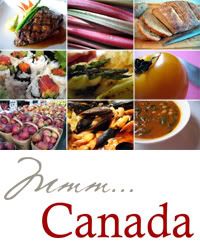
Food from Canada


is a brilliant initiative from Jasmine. She and a friend called for a round up to gather recipes from Canada. The submissions seemed to have come from every corner and the end product is inspiring.
Just as French President Nicolas Sarkozy is asking the UN to award French cuisine Unesco humanity heritage status, previous winners in this field have included a Belgian carnival and the royal ballet of Cambodia, should we look at our respective national cuisine as immoveable heritage or melting pot in evolution?

Dressed to Impress: En Papillote

"En Papillote" is basically a posh denomination for a fun and easy way of cooking. Often applied to fish it can also be used for chicken or vegetables on their own.

All what you have to do is slice thinly the vegetables, wrap all the items in a parchment or a tin foil and cook the parcel in the oven gas mark 200C for 20 minutes or on the barbecue so that the food cooks in its own juices, keeping the moisture in the bag which will swell with hot steam. When cook slide the bag on the diner's plate and watched at they unwrapped their parcel, never falls to impress, serve with new potatoes or couscous or rice

It is an healthy way of cooking which suits perfectly food with delicate flavour here are some ideas:

Dry vermouth or dry white wine, thyme, parsley, dill with fennel, carrot, celery and shallot or onion.

note that fennel has a strong flavour which is not to every body's taste could be replaced by leek

A taste of the East : Soya sauce, a splash of sherry, just a drop of sesame oil with julienne of ginger, garlic, sweet peas

Be adventurous: White wine or dry vermouth, tangerine or orange slices, fennel, red onion, chives

Provencal style: Chopped (seeded, drained) tomatoes, olives, oregano,capers, garlic.

North African way: garlic clove, 1 tsp cumin seeds, extra virgin olive oil, juice of 1 lemon + zest or one finely chopped preserved lemon,1 jalapeƱo pepper, seeded 1 bunch coriander, salt & pepper to taste

Now for the more complex question of which fish? whole gutted and clean trouts, soles, salmon fillets, breams mostly farmed so sustainable, they never achieve the same flavour as there "free range" counterpart but when it comes to cod should we still provide a demand when stock are being depleted? is there still plenty of fish in the sea?
My understanding is that the quotas are not doing much good as a lot of the cod is caught by trawling-nets when fishing other species and then thrown back in the sea. As consumers we seem to be only a small part of the answer, the solution resting firmly with the political powers and the fishing industry.
My answer to that one is that I have not stopped buying cod but I diversify what I buy and look out for new yummy recipes, don't hesitate to comment would love to know how you tackle the issue.

Fun with Jam Drops

"A cup of coffee, friends and a natter" rates in the top five of my feel-good list at the moment, so yesterday as I was getting food ready for diner, Anne was coming around, I thought it would be nice to finish the meal with coffee and biscuits, slumped in cosy corner, exchanging news. Looking for a biscuit recipe in my new bible "the baker" by Leanne Kitchen, I knoooow, I still can't believe it is a real name either, but more of this in another post, I spotted jam drops.

When I was very small, at school, they taught us how to make "lunettes", biscuits shaped like spectacles, sprinkled with icing sugar, the eyes filled in with jam. Jam drops obey the same principle and they could have been named "eye balls" but I guess that would not have been very appetizing. There is nothing to them, they are a little time consuming to make but I have not had so much fun in the kitchen for a long time and they are delicious.


Jam Drops

Makes 32
Ingredients:

80g unsalted butter, softened
1/3 cup / 80g caster sugar
2 tblsp milk
1/2 tsp vanilla essence
1 cup /125g self-raising flour
1/3 cup/40g custard powder or instant vanilla pudding mix
1/3 cup raspberry jam/100g ( I used recently home made strawberry jam)

Method:
1. Preheat the oven to moderate 180C/ 350F/Gas 4 and line two baking trays with baking paper.
2. Cream the butter and sugar in a small bowl with electric beaters until light and fluffy, or a fork will do, Add the milk and vanilla and beat until combined. Add the sifted flour and custard powder and mix to form a soft dough. Roll heaped teaspoons of the mixture into balls and place on the trays.

3. Make an indentation in each ball using the end of a wooden spoon. Fill each hole with a little jam. Bake for 15 minutes, cool slightly on the trays, then transfer to a wire rack to cool.
Jam drops will keep up to 7 days, stored in a cool place in an airtight container, or can be frozen in which case, you will have to be really fast as they disappear so quickly.

Not Quite A Domestic Goddess Yet : Tomato Tarte Tatin

For me Tatin conjures up images of cataclysm, well, what can you expect from a recipe created out of an accident.
Once upon a time "there was 2 spinster sisters who lived in Lamotte-Beuvron, a small rural town in the Loire Valley of France, owned and ran the hotel called l'Hotel Tatin in 1888. The elder sister, StƩphanie, dealt with the kitchen. She was a particularly fine cook but was not the brightest of people. Her specialty was an apple tart, served perfectly crusty, caramelized and which melted in the mouth. One day during the hunting season, during the midday scramble, Stephanie placed her tart in the oven the wrong way round. The pastry and apples were upside-down but, nevertheless, she served this strange dessert without giving it time to cool. The French call this dessert tarte des demoiselles Tatin".
Once upon another time, much much later than 1888, my parents where invited to stay with his mum who then run a lovely B&B where everything was perfect in the Peak District. My dad always keen to show his culinary talents took upon himself to make une Tarte Tatin, there was lots of excitement all around as he swapped his persona for that of a stereotypical male chef : giving orders, swearing a lot. What we had not foreseen was that there is a world a difference between cooking with a gaz stove and a metal plate and using an halogen cooker with china dishes.

It took no time for the china to explode, the melting caramel to burn on the halogen, my dad to swear even louder, his mum to run around in horror, mine to try to help and me to wish that the cursed Tatin sisters had never been born.

Understandably, Tatin remained a taboo recipe for a long time, I can only eat savoury Tatins but never attempted to make one until the other day, as I was reviewing Easy Food magazine, I was attracted to the Tomato Tarte Tatin like a magnet to the fridge. As far as I know curiosity only kills cat, so I tried. It is just delicious, though you will agree the presentation was worthy the sisters' first attempt.
TOMATO TARTE TATIN
As seen in Easy Food Magazine
serves 4-6
Ingredients:
2 tbsp balsamic vinegar
2 tbsp caster sugar
1 tbsp thyme leaves
finely chopped
400g cherry tomatoes
1 sheet ready-rolled puff pastry
cut to fit over a 20cm/8in ovenproof flan or quiche dish
100g mozzarella
goat’s cheese or Parmesan shavings
Fresh basil leaves
to garnish
2 tbsp olive oil for drizzling

Method:

Preheat the oven to 200C/gas mark 6 and grease an ovenproof quiche or flan dish with a little butter and set aside.

Put the balsamic vinegar, sugar, and thyme into a nonstick frying pan and heat until the sugar has melted. Bring to boil. Add the tomatoes and stir until they are completely coated with the syrup. take the frying pan off the heat and set it aside to cool.

Arrange the tomatoes in the bottom of the buttered dish and drizzle the sauce on top. Unroll the puff pastry and flatten out slightly with a rolling pin. Cute out a round slightly larger than the buttered dish. Place the circle of pastry on top of the tomatoes. Trim the edges or tuck them down the sides of the dish.

Bake the tart in the preheated oven for 25 minutes, or until it is well risen and golden brown. Place a large serving dish upside down on top of the tart dish and carefully turn it upside down so that the tomatoes are on top, protecting your hands with a thick towel.

Tear the mozzarella cheese into small pieces and sprinkle over the tomatoes. Garnish with a few leaves of fresh basil and serve drizzled with a little olive oil.

Fat 28g - Carbs 40g - Energy 437Kcal - Protein 9g - Sodium 3g - Fibre 3g
Tale of the tarte Tatin found in whatscookingamerica.net
En Francais dans le texte
TARTE TATIN A LA TOMATE
POUR 4-6
IngrƩdients :
2 cuillĆØres a soupe de vinaigre balsamique
2 cuillĆØres a soupe sucre semoule
1 cuillère a soupe de thym finement haché
400g tomates-cerises
1 feuille de pâte feuilletée prêt-roulée
coupez pour l'adapter au-dessus d'un plat a flan 20cm
100g de fromage de chĆØvre ou copeaux de parmesan
Feuilles fraƮches de basilic
pour garnir
2 cuillĆØres a soupe d' huile d'olive
MƩthode :

PrƩchauffez le four 200C/gas Ơ la marque 6 et graissez un plat a tarte allant au four avec du peu de beurre et le mettez de cƓtƩ.
Mettez le vinaigre balsamique, le sucre, et le thym dans une poêle antiadhésives et faire chauffer jusqu'à ce que le sucre ait fondu. portez a ebullition.
Ajoutez les tomates et remuez jusqu'à ce qu'elles soient complètement enduites du sirop. retires la poêle outre du feu et placez-la de cÓté pour faire refroidir.

Arrangez les tomates au fond du plat beurrƩ et versez la sauce sur le dessus.
DĆ©roulez la pĆ¢te feuilletĆ©e et l'aplatissez dehors lĆ©gĆØrement, decoupez un rond lĆ©gĆØrement plus grand que le plat beurrĆ©. Placez le cercle de pate sur les tomates. Ɖquilibrez les bords ou rempliez-les sur les cĆ“tĆ©s du plat.

Faites cuire la tarte dans le four prƩchauffƩ pendant 25 minutes, ou jusqu'Ơ ce qu'elle soit bien levƩe et brun d'or.
Sortes du four, placez un grand plat sur le plat a tarte et tournez-soigneusement a l'envers de sorte que les tomates soient sur le dessus, en protƩgeant vos mains avec une serviette Ʃpaisse.
"DƩchirez" la mozzarella en petits morceaux et places les au dessus des tomates. Garnissez avec quelques feuilles de basilic frais et une peu d'huile d'olive.

Gras 28g - Glucides 40g - Ɖnergie 437Kcal - ProtĆ©ine 9g - Sodium 3g - Fibre 3g


si

LinkWithin

Related Posts with Thumbnails